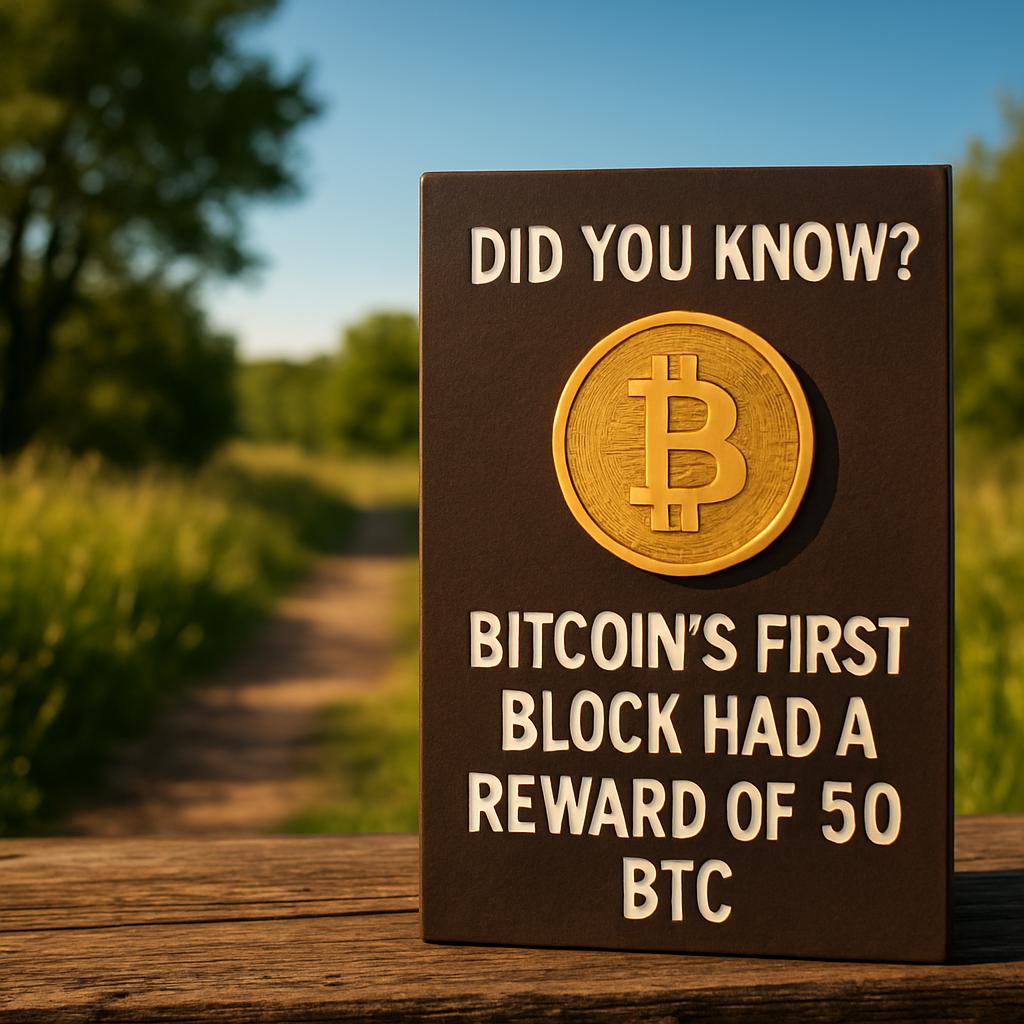
Did You Know? Bitcoin’s First Block Had a Reward of 50 BTC
Table of contents
- What was the reward for Bitcoin’s first block?
- Why did Bitcoin’s first block have a 50 BTC reward?
- How did the reward system impact early Bitcoin mining?
- What happened to the 50 BTC reward after the first halving?
- What is the significance of the Genesis Block’s 50 BTC reward today?
- Frequently Asked Questions
Bitcoin’s inception marked a new era in digital currency, and its very first block, known as the Genesis Block, holds a special place in crypto history. Many newcomers to Bitcoin might not realize that this initial block carried a block reward of 50 BTC, setting the stage for the mining incentives that drive the network today. Understanding this fundamental aspect helps grasp how Bitcoin’s decentralized system began rewarding miners and securing the blockchain from day one.
What was the reward for Bitcoin’s first block?
The first-ever Bitcoin block, mined by Satoshi Nakamoto on January 3, 2009, included a block reward of 50 bitcoins. This reward was part of Bitcoin’s protocol to incentivize miners to validate and secure transactions on the network.
- The 50 BTC reward was fixed for the initial period before the first halving event.
- This reward is how new bitcoins enter circulation.
- The reward amount is halved approximately every four years, reducing new supply over time.
Bitcoin’s early miners received these 50 BTC as a form of compensation for their computational work, ensuring the network’s security and transaction processing.
Why did Bitcoin’s first block have a 50 BTC reward?
Bitcoin’s design includes mining rewards to compensate participants for maintaining network integrity. Satoshi Nakamoto set the initial reward at 50 BTC to balance incentivizing miners while controlling inflation of the currency supply.
- The 50 BTC reward reflected the starting point of Bitcoin’s issuance schedule.
- Mining rewards motivate miners to contribute computing power.
- The reward halves every 210,000 blocks, roughly every four years, decreasing issuance over time.
This reward structure helps maintain scarcity, mimicking precious metals like gold, while providing miners with ongoing incentives to keep the blockchain operational.
How did the reward system impact early Bitcoin mining?
In Bitcoin’s earliest days, mining was accessible to individuals with ordinary computers, as the network’s difficulty was low. The 50 BTC reward made mining potentially profitable, encouraging enthusiasts and developers to participate.
- Early miners could earn significant BTC with modest hardware.
- Mining difficulty and network participation were low, increasing chances of mining a block.
- The reward helped bootstrap the network by attracting more miners.
As Bitcoin’s popularity grew, mining difficulty increased, requiring more specialized hardware and larger energy inputs to secure the blockchain.
What happened to the 50 BTC reward after the first halving?
Bitcoin’s protocol includes halving events where the block reward is cut in half every 210,000 blocks. The first halving occurred in late 2012, reducing the reward from 50 BTC to 25 BTC per block.
- Halving events reduce the rate at which new bitcoins are created.
- These events help control inflation and preserve Bitcoin’s scarcity.
- The reward continues to halve roughly every four years, with the current reward at 6.25 BTC (as of 2024).
Halvings are significant moments in Bitcoin’s history, often influencing market dynamics and miner strategies.
What is the significance of the Genesis Block’s 50 BTC reward today?
The Genesis Block’s 50 BTC reward remains a symbolic cornerstone of Bitcoin’s origin story. Although these initial bitcoins cannot be spent due to the block’s unique structure, their existence highlights the network’s beginning and the reward system that sustains it.
- The 50 BTC in the Genesis Block are unspendable due to the block’s coding.
- This block includes a hidden message referencing a newspaper headline from January 2009.
- It marks the start of Bitcoin’s decentralized ledger and mining incentive model.
Understanding this reward offers insight into Bitcoin’s economic design and the mechanisms behind its security.
Frequently Asked Questions
How much was Bitcoin’s first block reward?
Bitcoin’s first block reward was 50 BTC, given to the miner of the Genesis Block on January 3, 2009.
Why can’t the 50 BTC from the Genesis Block be spent?
The 50 BTC in the Genesis Block cannot be spent because the block’s coding lacks a valid transaction input, effectively locking those coins permanently.
When did Bitcoin’s block reward change from 50 BTC?
The block reward halved from 50 BTC to 25 BTC after block number 210,000, which occurred in November 2012.
How often does Bitcoin’s block reward halve?
Bitcoin’s block reward halves approximately every 210,000 blocks, or about every four years, gradually reducing new bitcoin issuance over time.