Stacks Explained: Building DeFi and Apps on Bitcoin
Table of contents
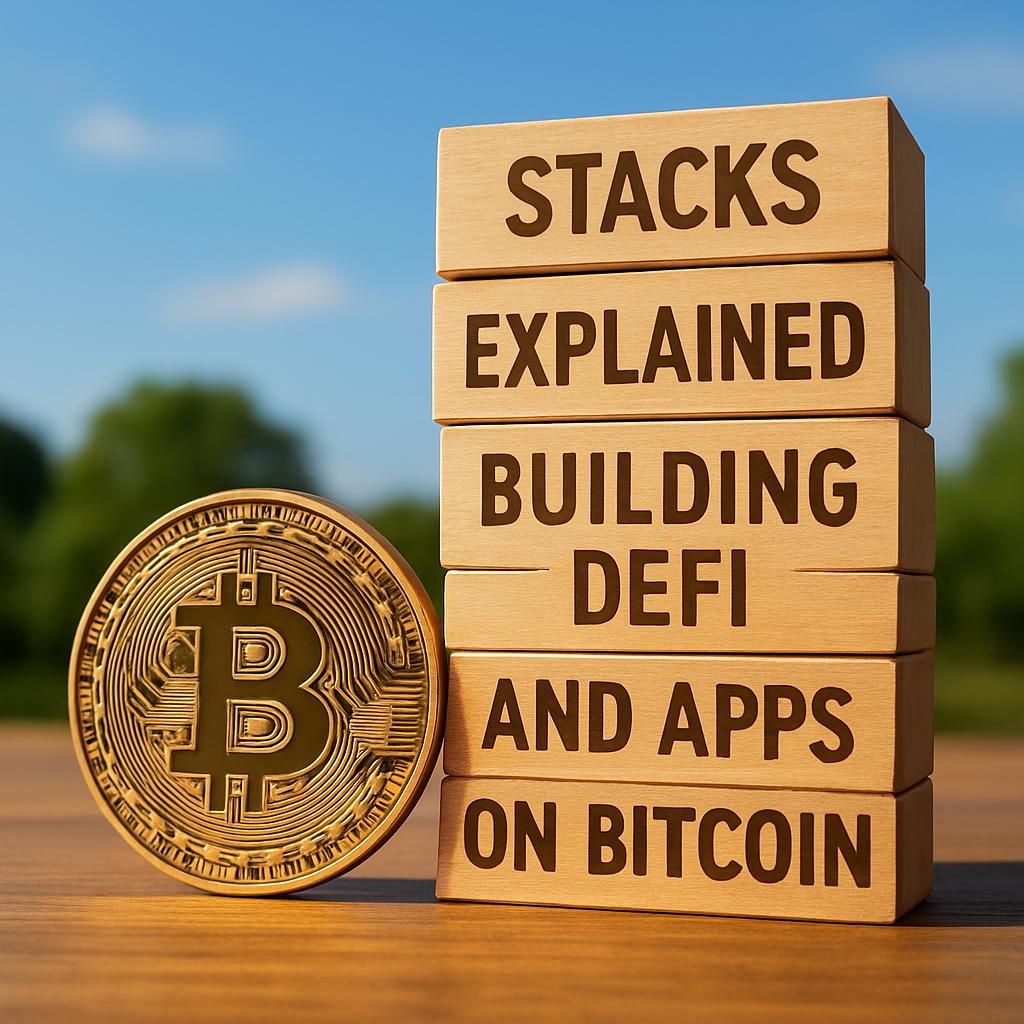
Bitcoin has long been recognized as the pioneer of decentralized digital currency, but its design limits complex applications beyond simple peer-to-peer transactions. Enter Stacks—a blockchain platform that unlocks the potential for decentralized finance (DeFi) and smart apps directly on the Bitcoin network. By combining Bitcoin’s unmatched security with a new layer of programmability, Stacks is enabling developers to build innovative applications that leverage Bitcoin’s trust and liquidity. Let’s explore how Stacks works and why it matters for DeFi and app development on Bitcoin.
What is Stacks and how does it connect to Bitcoin?
Stacks is a layer-1 blockchain designed to bring decentralized applications and smart contracts to Bitcoin without altering the original Bitcoin protocol. Instead of modifying Bitcoin itself, Stacks operates as an independent chain anchored to Bitcoin’s blockchain through a unique consensus mechanism called Proof of Transfer (PoX).
Key features of Stacks include:
- Bitcoin anchoring: Every Stacks block references a Bitcoin block, inheriting Bitcoin’s security.
- Proof of Transfer consensus: Miners spend Bitcoin to compete for the right to mine new Stacks blocks, linking the two networks.
- Clarity smart contracts: A new, predictable smart contract language designed for safety and simplicity.
- Native Stacks token (STX): Used for transaction fees, smart contract execution, and network participation.
With this architecture, Stacks enables the creation of apps and DeFi protocols that settle finality and security on Bitcoin, combining the best of both worlds.
How does Stacks enable DeFi on Bitcoin?
Bitcoin’s original design does not support complex programmable contracts, which limits the development of DeFi applications like lending, borrowing, and decentralized exchanges directly on its blockchain. Stacks solves this by introducing programmable smart contracts through Clarity, allowing developers to build sophisticated financial primitives while relying on Bitcoin’s security.
DeFi capabilities on Stacks include:
- Decentralized lending and borrowing: Users can lock assets, earn interest, or take loans through transparent smart contracts.
- Non-custodial exchanges: Swap tokens without middlemen, maintaining control over private keys.
- Yield farming and staking: Earn rewards by providing liquidity or staking STX tokens.
- Bitcoin-backed assets: Create wrapped or synthetic Bitcoin assets usable in DeFi protocols.
Stacks DeFi ecosystems are growing rapidly, with projects focused on interoperability, user-friendly wallets, and innovative financial products anchored to Bitcoin.
What programming language does Stacks use for building apps?
Stacks uses Clarity, a smart contract language designed specifically for safety, predictability, and simplicity in decentralized applications. Unlike many other smart contract languages, Clarity is interpreted rather than compiled, which helps avoid unexpected contract behavior and bugs.
Benefits of Clarity include:
- Predictable execution: Developers can analyze contract behavior before deployment.
- Decentralized verification: Contracts can be audited and verified on-chain.
- Bitcoin integration: Clarity smart contracts can interact with Bitcoin blockchain data.
- Readability: Syntax resembles Lisp, making it accessible for developers familiar with functional programming.
Clarity’s design reduces risks associated with smart contract bugs and enables complex logic for DeFi and app development on the Stacks blockchain.
How does Stacks ensure security through Proof of Transfer?
Proof of Transfer (PoX) is an innovative consensus mechanism that anchors Stacks to Bitcoin by requiring miners to spend Bitcoin to mine new Stacks blocks. PoX works by:
- Miners commit BTC as part of block production.
- The spent BTC is transferred to STX holders, rewarding them passively.
- New STX tokens are minted as rewards for miners.
- The Bitcoin blockchain serves as a secure reference point for Stacks blocks.
This process ensures that Stacks inherits Bitcoin’s security properties because every Stacks block depends on the latest Bitcoin block. PoX also aligns incentives between Bitcoin holders and Stacks participants, creating a mutually beneficial ecosystem.
What types of decentralized apps can be built with Stacks?
Stacks supports a wide range of decentralized applications that leverage Bitcoin’s security and the programmability of Clarity smart contracts. Common app categories include:
- DeFi platforms: Lending, borrowing, decentralized exchanges, asset management.
- NFT marketplaces: Minting, buying, and selling unique digital collectibles connected to Bitcoin.
- Social networks: Decentralized identity, messaging, and content sharing without centralized control.
- Gaming: Blockchain-based games with provable ownership and transparent mechanics.
- Data storage and verification: Timestamping and proof of data existence anchored to Bitcoin.
Developers appreciate Stacks for its robust infrastructure, clear developer tools, and growing community support, making it a compelling choice for Bitcoin-based dApps.
Frequently Asked Questions
What is the difference between Stacks and Bitcoin?
Stacks is a separate blockchain designed to add smart contract functionality and decentralized apps to Bitcoin, which itself does not support complex programmability. Stacks anchors to Bitcoin for security but operates independently using its own token (STX) and consensus.
Can I use Bitcoin directly in Stacks apps?
While Stacks smart contracts cannot directly move Bitcoin, they can reference Bitcoin transactions and create wrapped or synthetic Bitcoin assets that represent BTC within the Stacks ecosystem for use in DeFi and apps.
How secure is the Proof of Transfer mechanism?
Proof of Transfer leverages Bitcoin’s established security by requiring miners to spend BTC to produce Stacks blocks. This anchoring means attacks on Stacks would require compromising Bitcoin’s network security, making it extremely robust.
How do I start building apps on Stacks?
Developers can start by learning Clarity smart contracts, using the Stacks blockchain testnet, and leveraging developer tools such as the Stacks.js library and the Hiro wallet. Extensive documentation and community support are available on the official Stacks website.